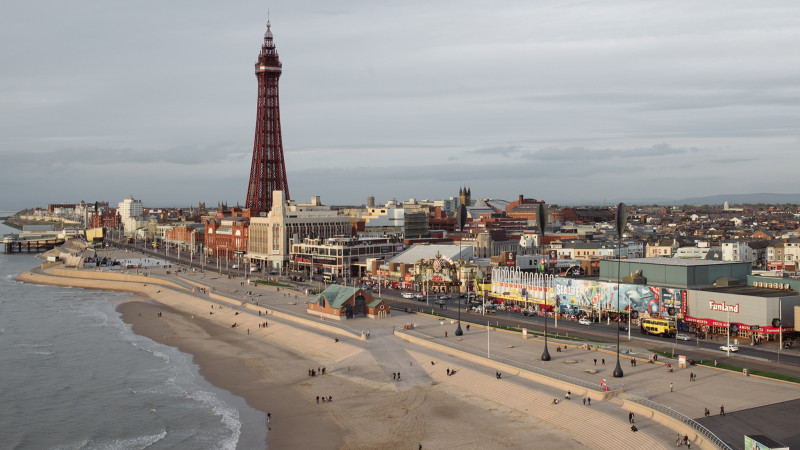
This is a brief essay in response to Sarah O'Connor's article in
The Financial Times Weekend Magazine published on Saturday 16 November 2017
(O’Connor & Burn-Murdoch, 2017), the conversation it triggered locally and nationally. It is also a response to the meeting held by LeftCoast, ‘Left Behind – Blackpool a Drop Out Town?’ on 18 January 2018 and the mini-manifesto produced by LeftCoast, which will form the foundation for, Left Behind... #2 - Creative Conversation on the 8 February 2018.
The article prompted a renewed personal interest in the decline and fall of Blackpool. I arrived on the Fylde Coast in 1971. Blackpool was in full swing but the chains were well rusted through and it was clear from the public debate and the newspaper headlines that the infrastructure and superstructure were starting to crumble. Family holidays were in decline but weekends, particularly during the “Lights”, were more popular than ever if the number of cars queuing to get into Blackpool on a Friday evening was anything to go by, and this was pre M55.
Sarah O'Connor's article laid bare the problems of economic decline, low wage economy, social deprivation and the evidence of conflicting government legislation, re benefits, and muddled thinking by local and regional politics. Digging in the archives revealed a library of dust covered reports of one sort or other going back to 2003 and probably further if I could have raised the enthusiasm to look. These were reports that identified all the problems and offered a range of miracle solutions to halt Blackpool’s economic decline and cure the resultant social deprivation. Then there were the government reports offering analysis, solutions and in some cases olive branches and the occasional wad of money to reinvent, save and invigorate coastal or seaside towns and liberate them of their post-industrial ills. Inevitably to add cream to the mouldering pile there are the academic papers and reports that say all the same things but in a language that no one understands.
All of this makes very interesting if not depressing reading particularly when you realise they all use the same words occasionally rearranged, come to the same solutions and offer the same advice which always costs too much to implement even if it was sound in the first place. I sound cynical. It is clear that over the years Blackpool backed the wrong horses, allowed vested interests and petty politics to cloud their judgment. For example in the 70’s they decided to build a zoo rather than the equivalent of the NEC Exhibition Centre and Birmingham’s Conference Centre, a University was mooted for the same location. Local interests blocked such developments first because they did not want town centre trade moving the outskirts of the town and many of the local politicians lived in the proposed development area and they didn’t want any noisy students disturbing the peace and tranquillity of the locality. However, not to repeat the mistakes of the recent past local worthies were excited by the prospect of Blackpool becoming the Las Vegas of the UK by bidding for the Blair Governments national rescue package to flood the country with Casinos. The prospect of avarice beyond dreams was too much and yet another report was commissioned. To cut a long story short Scottish Presbyterian Gordon Brown had a biblical moment or saw sense and quashed to plan, well more or less. The result was Blackpool fell into a black-hole; the early noughties were a bad time for Blackpool.
If Sarah O'Connor's article has done one thing is generated a local and national debate, the centre of which is Blackpool. It has even had the unlikely outcome of introducing a new audience to the FT, no mean feat. The article though well researched and written overlooked some of the relevant histories and avoided mentioning the infrastructure changes that have and are taking place in and around Blackpool in that past few years. New seafront and promenade, new trams and buses, major upgrades to the main gateways into Blackpool. Very significant investment into existing attractions such as the Pleasure Beach, which constantly reinvents itself and gets very little recognition, that’s another story. Major investment in new brand and upmarket hotels, and at long last a conference centre as part of a major refurbishment of the Winter Gardens complex. The upgrade and electrification of the west coast mainline link to Blackpool and all points North, South and East and with this, a major revamp of Blackpool’s’ railway stations.
Something else the article failed to acknowledge is the contribution made to this reinvention of Blackpool by culture and art led interventions. One of the cornerstones of most of the reports relating to the regeneration of coastal towns is the role played by cultural and artist let initiatives. The creative community has been responsible for initiating a number of notable if not spectacular regeneration projects in, Hastings, Margate, Brighton, Folkestone, Great Yarmouth and, not least, in Blackpool; note the geographical bias. This is echoed by successful cultural and creative programmes of both economic and social regeneration in non-coastal communities namely, Manchester, Liverpool, Leeds, and even Hebden Bridge.
But what of Blackpool and it's precarious limbo state of deprivation as portrayed in the FT article? As stated earlier the purpose of this essay is twofold, firstly to link the FT article with the ensuing response by both the local and the creative communities. Secondly, as a segue into my art practice and my creative contribution to the debate. As a starting point for both issues, what better place to seek the answer to that question than at the bar of a local watering hole. The beer-bellied and dodgy denture wearing, bar room lawyers, are always ready to make a comment and provide advice on any subject no matter how mundane or convoluted. That is if you can get them to stop discussing Brexit, with their veiled racist rhetoric and endless pronouncements on the benefits system. Who knows, there may be a pearl of wisdom to be had from one or more of the brethren gathered in the “Snug”.
For those who could not afford to fork at 5 quid on a Saturday for the FT weekend magazine, or did not know that such a publication existed, I regaled the assembled, with the gist of Blackpool’s sorry state as portrayed in O’Connor’s article. One old acquaintance took the bait and had me opening the notebook app on my phone to record his words of wisdom. Mobile phone's being normally prohibited in this company.
Jim (not his real name, in case he reads this) is a Sandgrown’un, (one born within sight of Blackpool Tower, more or less) in his mid-seventies (aren’t we all?), an ex-maths teacher, ex-hotelier and now a Blackpool landlord. Not the pub variety but the privately rented accommodation variety. At 76 Jim is a tad older than me but still ride his Triumph Thunderbird most days and when not tending his flock of tenant’s, pandering to their every need, and keeping an eye open for anybody stepping over the line. Jim is very sharp, a man who can read a balance sheet at 40 paces and a very shrewd businessman. So, what is your view of Blackpool and its problems Jim, I asked him? He quickly rattled off 3 opinions, which I felt hit the nail on the head. I was so taken with the poignancy of the points he raises, I asked him to repeat his words so that I could note them down.
One, when the government stopped paying housing benefits directly to landlords, tenants, many of whom struggle to survive on the remainder of their benefits, suddenly had their rent money to manage. The result, the streets of Blackpool were suddenly flooded with drug dealers keen to take advantage of the situation, an upsurge in smack heads and alcoholics was the result. People stopped paying their rent, eviction soared, a nightmare unfolded.
Two, they change the rules again; tenants could apply to have rent paid directly to the landlord depending on the tenant's circumstances. The bureaucracy was a nightmare, but the money supply on the streets dried up. The drug dealers disappeared, well not completely but they were less evident, alcohol sales fell, and there were fewer drunks about. There was a
reduction in unpaid rent and inevitably evictions. But the situation never fully recovered.
Three, then they started messing around with the housing benefits again with, age-related caps, invalidity benefits, bedroom taxes etc etc. This brought with it a whole new set of problems mainly those people who weren't receiving enough housing benefit to pay the rent and it's not as though rents in Blackpool are high. The result of this was an increase in people sleeping on the streets and homelessness in general. Begging increased both legit and organised. Inevitably this cash was spent on booze and drugs, particularly the cheap booze, the 2L bottles of cider and the latest drug craze, “legal highs" such as "Spice".
Oh yes there was a fourth point, Blackpool Council decided in an effort to eliminate rogue landlords and improve the standard of accommodation, particularly in HMO’s, houses of multiple occupancy, a great idea, but at what cost? The changes cost landlords a significant amount of money not only to meet the new specifications but to pay the significant licensing fees that went with it, namely £700 for an HMO and £1,000 for a flat. I had one HMO, Jim said, it had 10 rooms, but it was plagued with problems, bad payers, bad behaviour, vandalism etc etc. I decided to convert the property into self-contained flats but this meant my license went from £700 to £1,000. What sort of incentive is that for landlords to upgrade property?
Jim’s experience is reflected in the numerous reports, manifestos, master plans, call them what you will, that have been generated in the past 15 years or so outlining Blackpool's plans for the future. These independent documents all highlight the problems referenced in the FT article as do similar reports for other seaside towns. The social issues related to the post-industrial economic decline is exacerbated by increased stringency, complexity and obfuscation in relation to welfare and benefits legislation and administration and the impact this has on the local situation. The FT report highlights the important role of charities, particularly the CA (Citizens Advice), in lightening the burden of this situation and the influence it has on lives of those who rely on government benefits. In the grand scheme of things, the effects of welfare and benefits dependent effects are seen by the report writers as both threats and weaknesses when it comes to marketing the regeneration programme. In one of the most recent Blackpool focused reports, “Destination Blackpool - Resort Place-Making 2015-2017” the problem is euphemistically referred to as a Hygiene factor.
The report discusses the importance of the Charity sector in resolving welfare and mental health problems, particularly the Citizens Advice, the CA, formally known as the CA, Citizens Advice. It turned out that the wife of another of my drinking acquaintance’s works for the Blackpool CA. As the FT article identifies an organisation that offers a glimmer of hope to those doing battle with the System, a haven of sanity and sound advice in a melee of bureaucracy, endless convoluted forms and perceived pettiness. He confided that she was considering leaving the CA after many years of voluntary work, in a job that she loved the reason, poor morale, constant cuts in funding and a rise in petty bureaucracy, whilst dealing with an increase in demand for services that cannot be met. The cuts to voluntary sector funding mean the CA operates under third world conditions with clapped out equipment, primitive facilities and a virtual absence of modern technology. The organisation lives in fear of competition from commercially funded bodies invading the voluntary sector, backdoor privatisation as in the NHS. The one glimmer of hope for those struggling to survive at the margins of society looks as though it may be extinguished leaving the vulnerable and abused in an even more desperate situation than they currently find themselves. What effect will that have on the problems of Blackpool and the “left behind”?
References
O’Connor, S. & Burn-Murdoch, J. (2017) Left behind: can anyone save the towns the UK economy forgot? Financial Times. Available from: https://www.ft.com/blackpool [Accessed 5 February 2018].
Blackpool: a forgotten town
https://www.ft.com/video/d0fd944f-42a6-4f28-ae34-4c5a261ef05f
Left behind: can anyone save the towns the economy forgot?
https://www.ft.com/content/b6dbf34e-c987-11e7-aa33-c63fdc9b8c6c
Slowing Down to Listen in the Digital Age: How New Technology Is Changing Oral History Practice
https://academic.oup.com/ohr/article/44/1/94/3059832
Oral-History: List of all Oral Histories
http://ethw.org/Oral-History:List_of_all_Oral_Histories
Oral History in the Digital Age
http://ohda.matrix.msu.edu/best-practices/
Doug Boyd: Oral History in the Digital Age
https://www.youtube.com/watch?v=mhOPgBvO8V8
Amazon Transcribe
https://aws.amazon.com/transcribe/
What are Amazon Transcribe Alternatives and Competitors?
https://www.g2crowd.com/products/amazon-transcribe/competitors/alternatives