Pages

Saturday, March 28, 2015

The Making of Chang Art Work for Everton FC - Work in Progress

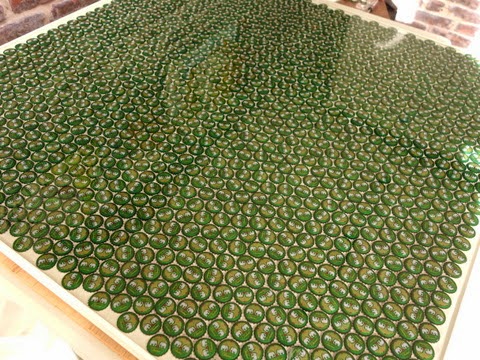
Sorting the good beer bottle tops from the bad... Only an other 5000 to go


Computer generated visual of final artwork...

Everton Crest Logo 


Testing patterns for the tops layout


Resin embedding test piece


Finished polyester resin casting

Full size artwork for laser cut stainless steel 


Positioning stencil for the stainless steel parts


Laser cut stainless steel as received


Stainless steel pieces in-situ


Finished Artwork

Monday, February 2, 2015

The Making of Chang Art Work for Everton FC - Test Piece Video


A short video showing the creation of a test piece fibre glass resin base for the artwork. This was to get the hang of using polyester resin and fibreglass reinforcement. 

Sunday, August 24, 2014

Reinforcing Stencils


alexsten1.jpg
Image courtesy of the Wooster Collective

Reinforce the delicate parts of a stencil by fixing them in place with thread or monofiliment nylon, such as fine fishing line. Use adhesive tape or hot melt glue to fix the thread in place. 

Saturday, September 29, 2012

MA Exhibition - Serendipity - Family Photograph - Video

This is a video of the installation Serendipity which is discussed in a previous post, see here for further information.

Thursday, September 27, 2012

Dissertation - Abstract and Synopsis

Self: The Photograph, Memory and Nostalgia

Abstract 

This enquiry takes the form of a personal reflective narrative within a theoretical framework influenced by the writings of Barthes, Sontag, Benjamin and others. It opens by briefly exploring the historical development of photography and the emergence of the photograph as a as the snapshot in the context of the family photograph. The enquiry considers the relationship between the family photograph and the development of autobiographical memory in turn a detailed exploration of the influence of autobiographical memory and the sense of self. Finally the dissertation explores the emotional influence of nostalgia as a catalyst in the development of a sense of self and place.

This dissertation is part of a larger body of work including a practice based exhibition comprising three installations which explore in turn; the notion of aging and mortality through the decay of memory and the ephemeral photograph; the family photograph and the uncanny nature of the pose based on a selection of family photographs spanning four generations; a simulation of the frailty of memory in which appropriated frames of decaying film stock are combined with familiar images in a dissonant melange of the familiar and the confused.

The enquiry is informed by a series of questions: Is my art practice born out of a sense of self and agency? What are the influence of autobiographical memory and the emotion of nostalgia?

Synopsis

The objective of this dissertation is to explore the influences which have informed my art practice and which give rise to my recurring themes of decay, memory and nostalgia through the medium of photography, in its broadest terms.

My contention is that my practice is born out of a sense of self and agency moulded by the influence of autobiographical memory and the remembered self. I will argue that I am influenced by the cultural background and geography of my childhood the embodiment of which is the family photograph.
My enquiry is composed of two elements, the dissertation and a practice based exhibition. The dissertation will take the form of a personal reflective narrative. The practice component is based on the experimental aspect of my current practice with an emphasis on themes drawn specifically from the substance of my enquiry.

I shall open by exploring a brief history of photography and the emergence of the photograph as a medium and as an intrinsic part of family life whilst considering the influence of the photograph in the development of autobiographical memory in association with the family photograph and the family photograph album. This in turn will lead me to a more detailed exploration of the nature of autobiographical memory and the influence of memory on the development of the sense of self. Thirdly I shall explore the emotional influence of nostalgia as a catalyst in the context of self and place. Finally, I shall introduce the practice and contextual aspect of the dissertation.


Friday, September 21, 2012

MA Exhibition - Serendipity - Family Photograph

Serendipity – a homage to the family photograph album, the “snapshot” and the uncanny nature of the pose based on a selection of family photographs spanning five generations, intended to invoke memory and nostalgic emotion.


Following the invention of photography the family photograph album quickly became an essential part of family life as a means of storing paper prints but more than that, as a repository for memories,  a source of nostalgic reflection and trigger for story telling. 

The nineteen fifties saw the arrival colour photography and with this the 35mm colour transparency  which because of their small size, to be shown as a projected image. A symbol of the genre was the Kodak Carousel slide projector, another form of family photograph album. The darkened room and the sound of the slides changing evoke nostalgic memories for a whole generation.

The installation comprises digital projected images of old black and white photographs re-photographed from the family album to show elements of the textual information that accompanied the photographs in the album.

The installation simulated the walls of a room and the pages of a photograph album superimposed on these are the projected images from a Kodak Carousel projector overlaying and merging with the black and white images, occasionally giving rise to serendipitous juxtapositions and third images. The image selection emphasises the banality and commonality of the pose despite being separated by up to five generations in time.

The viewer will be prompted to consider their personal relationship with, and their experience of, the photograph as a means of spontaneously making new memories from old memories. Confronted by the banality of the pose in many of the images the viewer will be prompted to reflect upon similar poses within their own collection of photographs.

When viewing a family photograph album, the images are but single frames from a view of life which can be reconstructed into a variety of narratives be pendant upon the viewer’s relationship to them. A photograph captures the moment which immediately becomes the past. The imagery is fuel for the imagination, we see not only what is signified by the photograph but we recall related memories and emotions and our mind creates new images, our images.

To add an additional dimension to this installation a narrative sound track by family member, Bill Turner aged 80, my mothers’ second cousin, in conversation with me and my brother reflects on photographs from the family archive, not necessarily those being shown. The commentary demonstrates the role of the photograph as a record of social history and an aide memoir.  The objective of the installation is to explore how family photographs shape our memory by triggering remembering and random thoughts, whilst prompting the viewer to consider how they remember their own family photographs and related memories.

Medium: Projected digital image of original photographs, analogue  projected colour transparency [slide], with commentary.

This is a slide show compiled from stills from the presentation, for a full length video [6min 34sec] of the presentation see here.

MA Exhibition - Memento Mori

Memento Mori – a form of invocation which explores the notion of ageing and mortality through the decay of memory in relation to the ephemeral but enduring photograph.


Perusing a family photograph album I came across a photograph of my mother as a beautiful young woman at the age of 18, I was reminded of the last time I saw her before she died, a frail old lady of 78. 

I was suddenly overwhelmed by my own sense of mortality how long would it be before a member of my family contemplated my photograph and reflected on my passing. 


Roland Barthes had been similarly affected by the finding of a photograph of his mother as a young girl. His ultimate response was to contemplate death, the death of his mother and himself. Barthes was of course mourning the recent loss of his mother. 


My situation was rather different my mother had been dead for fifteen years. What the photograph made me realise, confronted with the prospect of my own death, was how I had been unable to grieve at the time of her death. 


This photograph was important to me as a memento mori, it was the way I wanted to remember her as a she appeared in this photograph rather than rely upon the insubstantiality and frailty of memory, which had already started to fade until revived by this photograph. 


The installation prompted by this reflective occasion considers the nature of the snapshot as a memento mori and as a signifier of mortality compared with, the insubstantiality and fragility of memory. 


The installation uses an iPad as the means of presentation, representing on the one hand a fading memory and on the other an enduring photograph. The installation is in the form of a peepshow with the intention of creating a sense of intimacy with the image and as a means of concentrating the gaze.
The presentation is in 4 parts, the photograph, the aging of the photograph [18seconds], the decay of the memory [78 seconds] and the reflection of the enduring photograph. 


The presentation is accompanied by a sound track by Leila – Underwater. Due to copyright restrictions I cannot include the soundtrack in the video, as an alternative, to hear the soundtrack open the YouTube version here before viewing Memento Mori.

Medium: iPad – Digital animation from original photograph with sound.